Subjects





The Sardinian flower is considered the oldest of the island's cheeses: its artisanal processing techniques were already described in the 4th century A.D. by the Latin agronomist Palladio Rutilio Tauro Emiliano. Sheep cheese par excellence from inland Sardinia, it is evenly distributed throughout Barbagia.
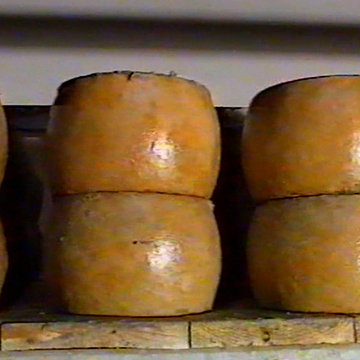
It is a hard and raw cheese, made exclusively with whole, fresh and raw milk of Sardinian sheep, coagulated with rennet in lamb or goat dough. The shapes, shaped by hand with special molds, have the characteristic “mule back” barefoot. After being originally marked and left in brine, they are lightly smoked and then aged in cool environments such as cellars.
The crust varies from deep yellow to dark brown, the paste from white to straw yellow. The flavor, decisive, becomes more spicy as it ripens: excellent for the table if eaten young, excellent for grating if seasoned.
The name derives from the ancient chestnut wood molds on the bottom of which a flower was carved, often accompanied by the initials of the manufacturer, which was imprinted on the faces of the shapes. Cited in the Stresa Convention of 1951, recognized as a Typical Denomination in 1955 and of Origin in 1974, the Sardinian Flower obtained the Protected Denomination of Origin in 1996 (Reg. CE n. 1107/96); it is protected by a Consortium based in Gavoi and by a Slow Food Presidium.
Bibliografia
Formaggi di Sardegna, a cura di M. Venusti. Regione Autonoma della Sardegna – Agenzia Laore, 2010, p. 15.
Formaggio e pastoralismo in Sardegna. Storia, cultura, tradizione e innovazione. Nuoro, Ilisso, 2015.
A. Guigoni, Il formaggio nei presidi Slow Food: marchi di qualità, in Formaggio e pastoralismo in Sardegna. Storia, cultura, tradizione e innovazione. Nuoro, Ilisso, 2015, pp. 653-664.
G. Murru Corriga, Dall’ovile al museo. Tecniche e strumenti della caseificazione tradizionale in Sardegna, in Formaggio e pastoralismo in Sardegna. Storia, cultura, tradizione e innovazione. Nuoro, Ilisso, 2015, pp. 665-692.
A. Pirisi, I formaggi tradizionali e a Denominazione di Origine Protetta, in Formaggio e pastoralismo in Sardegna. Storia, cultura, tradizione e innovazione. Nuoro, Ilisso, 2015, pp. 199-262.
P.G. Spanu, Dall’età fenicio-punica all’Alto Medioevo, in Formaggio e pastoralismo in Sardegna. Storia, cultura, tradizione e innovazione. Nuoro, Ilisso, 2015, pp. 29-40.
Regione Autonoma della Sardegna, Elenco dei Prodotti Agroalimentari Tradizionali (PAT), 2025.
Update
Video


 Facebook
 Twitter
 LinkedIn
 Whatsapp

 Print
 E-mail


Comments